
Why Is Medicai the Best for Image Exchange Solutions?
Many hospitals still send image files on USB drives or wait hours for external portals to load studies. The delays interrupt surgery schedules and force radiologists to repeat scans when the right prior images are missing.
By the end of this article you will know exactly how Medicai's zero-footprint viewer, cloud PACS, and AI tools change those daily workflows. You will have a clear list of questions to ask any vendor before signing the next contract.
What Is Medicai?
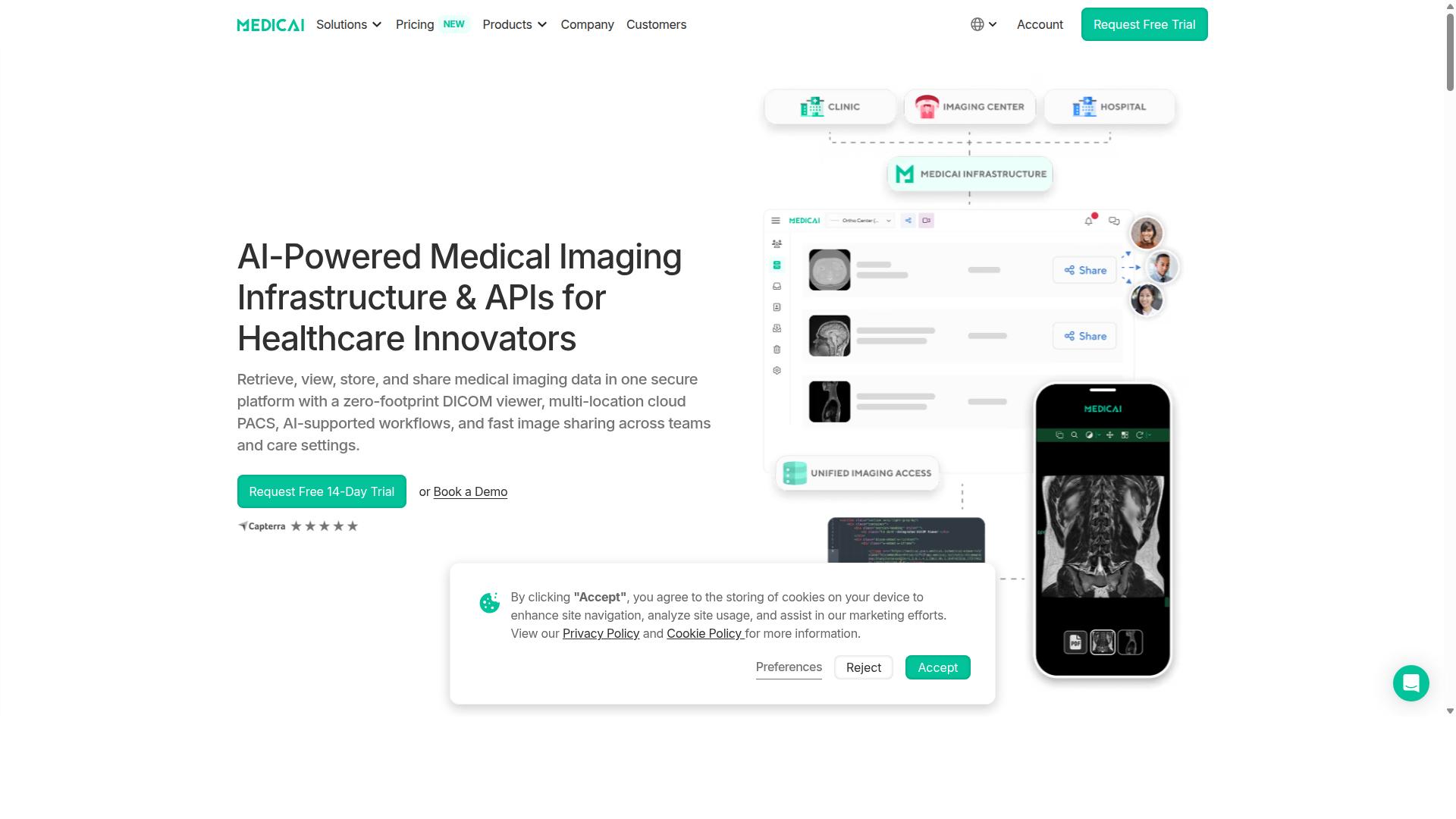
Medicai is a cloud-based medical imaging platform that provides a single secure environment for retrieving, viewing, storing, and sharing DICOM studies.
The platform includes a zero-footprint viewer that requires no local installation. Healthcare providers access studies directly through standard web browsers on any device.
Medicai maintains HIPAA and GDPR compliance to protect patient data. The system also holds FDA and CEE clearances for diagnostic use across multiple regions.
Its global availability supports hospitals, clinics, and imaging centers that need reliable medical imaging infrastructure. The platform serves as Imaging Infrastructure as a Service through a vendor neutral approach.
Medicai focuses on modernizing radiology workflows and enabling interoperability between different healthcare systems. This cloud PACS solution helps organizations manage diagnostic imaging data securely across multiple locations.
Why Medicai Excels at Image Exchange
Image exchange performance hinges on transfer speed, data integrity, and compliance; Medicai addresses each with concrete metrics and built-in safeguards.
Transfer speed matters most when referring physicians need fast access to diagnostic imaging across different locations. 50 M+ yearly API transactions demonstrate that Medicai handles high-volume exchange requests without creating bottlenecks in radiology workflow.
Data integrity depends on accurate transmission of medical imaging files and complete study routing. 1 M+ studies transacted per year shows that the platform manages large volumes of DICOM studies while maintaining the structure required for diagnostic use.
Compliance requirements include HIPAA and GDPR standards along with audit capabilities. 300 k+ DICOM visualizations in the last year indicates that Medicai processes substantial imaging data while staying within regulatory boundaries for patient data protection.
Key Features and What Makes Medicai Stand Out
Three core capabilities set Medicai apart in day-to-day radiology operations. The platform combines browser access, multi-site archives, and AI connectors into one coherent workflow. These elements address the typical friction points of image exchange without creating new layers of complexity for clinical teams.
Zero-Footprint DICOM Viewer
The zero-footprint viewer launches instantly in any browser, eliminating local software installs while preserving full diagnostic quality. Referring physicians and radiologists can open studies from any workstation and review findings together in real time. Because the images remain in the encrypted cloud, patient data never leaves a controlled environment.
Browser delivery removes the need for IT teams to maintain desktop clients across multiple departments. Collaboration happens inside the viewer, so second opinions or tumor-board discussions proceed without file transfers or version conflicts. Access logs and encryption protocols stay active throughout each session.
Multi-Location Cloud PACS
A single tenant can connect multiple hospitals or imaging centers to one unified archive without on-premise hardware. The Vendor Neutral Archive accepts studies from any modality and any vendor, creating a single source of truth for every location. Automated study routing sends new exams to the correct radiologist queue or backup site.
Disaster recovery runs continuously because every study is stored in geographically distributed, HIPAA-compliant data centers. When one site experiences downtime, others retain full access to the same patient records. This architecture removes the duplicate archives and manual backups that often slow enterprise imaging strategies.
AI-Supported Workflows
Pre-built connectors to FDA-cleared AI partners accelerate triage and measurement tasks inside the existing viewing session. The platform supports AI-supported workflows for radiology. Structured reports generated alongside the AI findings maintain a consistent record for referring physicians and downstream systems. The workflow remains intact whether staff review cases on desktop or mobile devices.
Pricing and Plans
Medicai offers transparent monthly subscriptions that scale storage and connected locations rather than per-study fees. This approach differs from traditional medical imaging platforms that charge based on study volume.
The Starter plan costs $249 monthly with 500 GB of cloud storage and unlimited user accounts. This tier suits small practices or radiology departments beginning their image exchange journey without connected locations.
The Standard plan costs $749 monthly and includes 2 TB of cloud storage plus one connected location. This option supports growing teams that need to link a single external facility for seamless DICOM transfer.
Enterprise customers receive custom pricing with multiple connected locations and external sites available. These plans accommodate healthcare organizations requiring extensive image sharing across various facilities.
Yearly billing provides 15% savings on both Starter and Standard tiers. Organizations pay $209 monthly for Starter or $639 monthly for Standard when selecting annual commitments.
DICOM Gateway setup requires a one-time fee of $1,000 per location. This infrastructure supports secure, encrypted transfer between PACS systems and the cloud platform.
Medicai provides a free 14-day trial of Starter plan features without requiring a credit card. Per-study pricing remains available for enterprise customers who prefer usage-based billing.
Overages are not required. Organizations select the tier that matches their current storage and connectivity needs, then upgrade as requirements evolve.
Trust Signals
Compliance and uptime certifications directly influence purchasing decisions in healthcare IT.
Healthcare organizations need reliable proof that their image exchange platform meets strict regulatory standards. Medicai addresses this requirement through documented compliance across multiple jurisdictions.
The platform maintains HIPAA compliance for United States healthcare data handling. This certification ensures proper safeguards for patient information during transfer and storage operations.
GDPR compliance covers European data protection requirements. Organizations operating across EU member states can rely on these standards for cross-border medical imaging workflows.
FDA and CEE clearance validates the viewing components used within the platform. These clearances confirm the software meets medical device safety standards for diagnostic imaging applications.
Security extends beyond certifications to actual data protection practices. Medicai stores over 1.7 million studies under encryption protocols that follow OWASP security guidelines.
This combination of regulatory approvals and encryption standards provides the trust signals that healthcare IT decision makers require when selecting image exchange solutions.
Who Should Use Medicai
Any organization that needs reliable, standards-based medical-image exchange across locations will find Medicai relevant.
Hospitals and health systems use Medicai to move diagnostic imaging between facilities. A radiology department can receive external studies directly into its PACS, eliminating physical media and manual uploads.
Orthopedics practices rely on fast image sharing before and after surgical procedures. Surgeons review outside MRIs and CT scans from referring physicians without repeated patient visits or repeat scans.
Oncology teams need complete imaging histories during tumor board meetings. Medicai lets multiple specialists view the same studies simultaneously, supporting coordinated treatment planning across sites.
Cardiology groups exchange echocardiograms and cardiac CTs with external labs. Secure transfer keeps patient data protected while allowing cardiologists to compare serial studies during follow-up visits.
Neurology departments send and receive brain and spine imaging for second opinions. Medicai supports the detailed DICOM data neurologists require for accurate interpretation.
Teleradiology groups use Medicai to receive studies from client hospitals around the clock. Radiologists access and report cases from any location, maintaining workflow continuity across time zones.
Final Verdict
For teams prioritizing zero-install access, multi-site connectivity, and measurable exchange volumes, Medicai presents a clear option. The platform focuses on image exchange solutions built around medical imaging needs.
Zero-footprint access eliminates software installation requirements across radiology departments. Teams can view and share diagnostic imaging studies without additional setup steps.
Multi-site connectivity supports coordinated workflows between locations while maintaining interoperability standards. This capability proves valuable for healthcare IT systems managing distributed operations.
Teams can reach Medicai USA at 7901 4th St N, STE 300, St. Petersburg, FL, 33702, phone +1 (832) 220 1035. Medicai Romania operates at 53-55 N Filipescu, 5th Floor, Sector 2, Bucharest, phone +40 316 305 875, email [email protected].
The solution addresses core image exchange requirements through established medical imaging protocols. Organizations evaluating platforms for DICOM handling and PACS integration find these contact points available for further discussion.
Recommended Resources: