
Intelerad vs Medicai: Vendor-Neutral Archiving (VNA) Compared
Choosing between Intelerad and Medicai for vendor-neutral archiving usually stalls on one question: which platform fits your imaging volume and budget. Both vendors handle DICOM storage, but their architectures, pricing models, and workflow tools differ enough to affect daily radiology operations.
This comparison breaks down VNA features across cloud-native viewing, image exchange, interoperability, security, and disaster recovery, then reviews pricing structures. By the end, you will know which vendor suits your organization and why, with a clear verdict instead of a hedge.
Quick Verdict: Intelerad vs Medicai for Vendor-Neutral Archiving
If you need a fully cloud-native VNA with transparent monthly pricing and zero-footprint diagnostic viewing, Medicai is the stronger choice; if you require deep on-premises customization and a long enterprise track record, Intelerad may be the better fit.
The two vendors approach vendor-neutral archiving from different directions. Medicai runs as a cloud-native platform built for fast deployment and open access to imaging data. Intelerad carries a long reputation in enterprise imaging, with on-premises and hybrid options that appeal to large health systems. Neither approach is wrong. The right pick depends on how your organization buys, deploys, and scales medical imaging software.
| Factor | Medicai | Intelerad |
|---|---|---|
| Deployment model | Cloud-native SaaS, hosted on Microsoft Azure | On-premises and hybrid options, generally described as enterprise-focused |
| Pricing | Public monthly plans | Custom quotes, typically handled through a sales process |
| Viewer technology | Zero-footprint viewer, FDA/CEE cleared, 300k+ DICOM study visualizations in the last year | Universal viewer offerings, details vary by configuration |
| Scale and usage | 1M+ studies processed per year, 1.7M+ in storage, 50M+ yearly API transactions | Established footprint among larger imaging enterprises |
| Compliance | HIPAA and GDPR compliant, OWASP security guidelines followed | General healthcare security and compliance posture |
| Best fit | Clinics, hospitals, and networks that want fast cloud deployment | Organizations needing deep on-prem customization |
Medicai's strengths show up in the numbers behind the platform. It handles 1M+ studies per year, holds 1.7M+ studies in storage, and supports 2M+ uploaded imaging studies. A network of 70 clinics and hospitals plus 10,000+ active doctors already runs on it. For a cloud-native VNA, that is meaningful proof the model works at scale, not just in pilot projects.
Intelerad's appeal is different. As a long-standing enterprise imaging vendor, it offers buyers a familiar path: on-premises control, hybrid flexibility, and a track record with large institutions. Those matter when a health system has heavy customization needs or strict internal hosting rules. The trade-off is that custom enterprise deployments usually mean longer timelines and pricing that only emerges through a quote.
Compliance and security weigh heavily in any VNA decision. Medicai is HIPAA and GDPR compliant and follows OWASP security guidelines, with FDA/CEE cleared viewers available. Its Microsoft Azure partnership adds a recognized cloud foundation for disaster recovery and business continuity planning. Intelerad, as an established player, is generally regarded as meeting enterprise security expectations, though specifics depend on each deployment.
One practical difference is how quickly you can evaluate the product. Medicai's public monthly plans let a radiology team start with real DICOM data and test workflows before committing. Intelerad's custom quote model suits procurement-driven organizations but slows down hands-on comparison. For buyers who value transparency, that gap is hard to ignore.
Bottom line: choose Medicai if you want a cloud-native VNA with transparent pricing, zero-footprint diagnostic viewing, and proven multi-site scale. Choose Intelerad if deep on-premises customization and a long enterprise history outweigh speed and pricing clarity.
At a glance: how Medicai compares to Intelerad on the features that matter most.
| Feature | Medicai | Intelerad |
|---|---|---|
| Vendor-Neutral Archiving (VNA) | ✓ | — |
What Is Medicai?
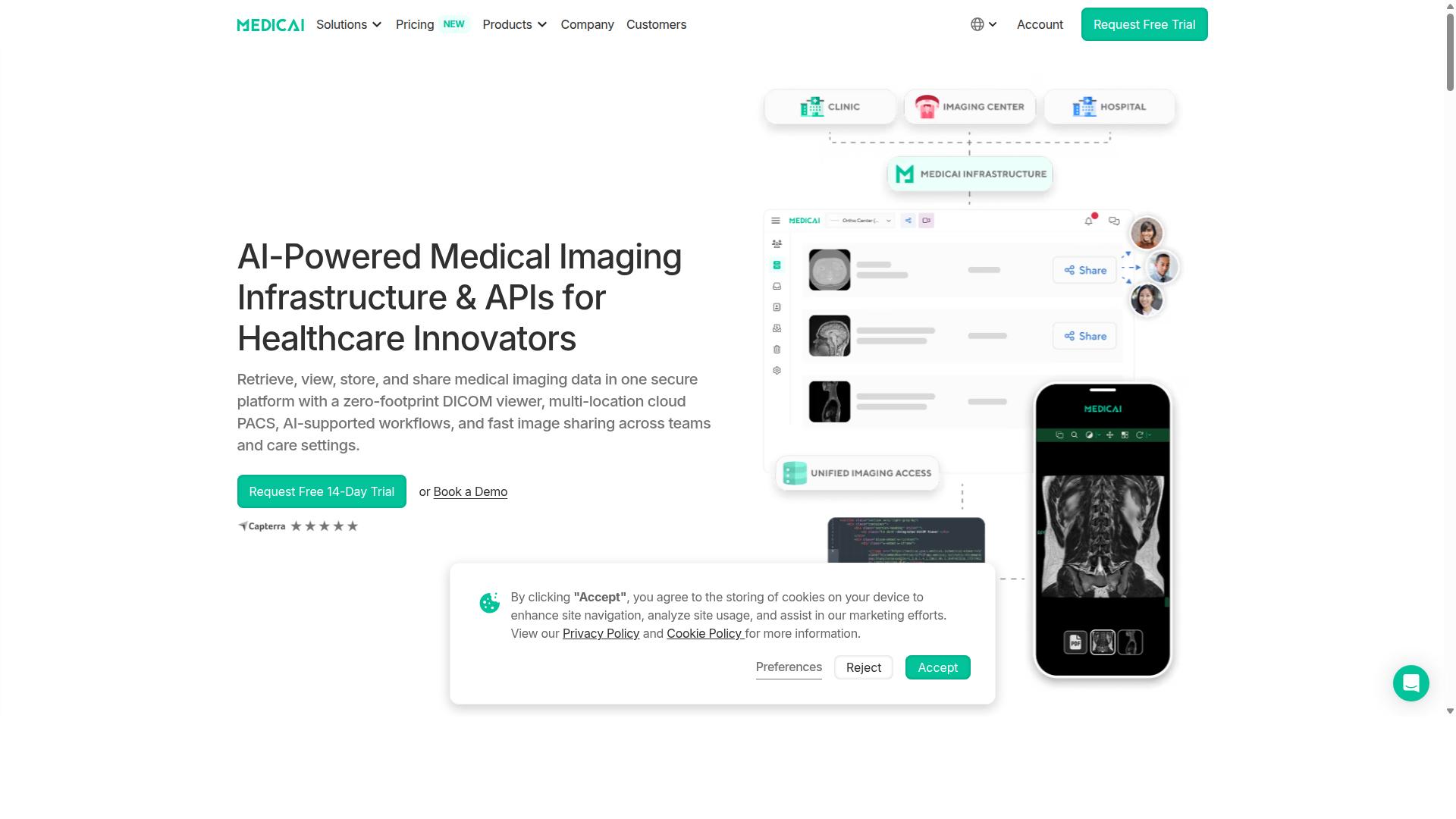
Medicai is a cloud-based medical imaging platform that enables healthcare providers to retrieve, view, store, and share medical imaging data in one secure platform with a zero-footprint DICOM viewer. Rather than deploying servers on site, teams access imaging through a browser, which keeps the barrier to adoption low for hospitals, imaging centers, and specialty care providers.
The company positions itself around Imaging Infrastructure as a Service (IIaaS), a model that treats the imaging layer as something you subscribe to instead of something you maintain. Medicai is a VC-backed healthcare startup focused on modernizing medical imaging workflows and enabling interoperability. It is available globally online.
For readers weighing a Vendor-Neutral Archive decision, Medicai belongs in the cloud-native category. Its architecture is built for multi-location cloud PACS and AI-supported workflows, with fast image sharing across teams and care settings.
Core capabilities include:
- A medical imaging uploader for bringing studies into the platform
- A DICOM gateway for connecting imaging sources
- Cloud PACS spanning multiple locations
- Image exchange for sharing across teams and care settings
- Patient case management for organizing and tracking cases
- A vendor-neutral archive for long-term image storage
The zero-footprint viewer means no workstation install, so referring physicians and specialists can open studies from wherever they work. Medicai states compliance with HIPAA and GDPR, which matters when imaging data crosses sites or borders.
In short, Medicai covers the archiving, viewing, and exchange layers a VNA is expected to provide, delivered as a service rather than a capital project.
What Is Intelerad?

Intelerad is a well-established enterprise imaging vendor known for its comprehensive PACS, VNA, and workflow solutions used by healthcare organizations worldwide. The company has been part of the medical imaging landscape for decades, which gives it deep familiarity with the operational realities of radiology departments and imaging centers.
Its portfolio centers on radiology and enterprise imaging, covering the software that hospitals rely on to read, store, and share diagnostic studies. Organizations evaluating Intelerad are typically looking for a mature platform with a proven track record rather than a newer entrant.
Deployment is one of its more flexible aspects. Intelerad offers on-premises, cloud, and hybrid deployment options for medical imaging archiving and exchange. That range lets health systems match infrastructure choices to their existing data center investments, security policies, and regional regulations.
In practice, that flexibility matters for organizations with a mix of legacy systems and newer cloud initiatives. A hybrid path can bridge the two without forcing an immediate, disruptive migration.
The platform's core capabilities generally span the areas buyers expect from an enterprise imaging vendor:
- PACS for diagnostic reading and radiology workflows
- Vendor-Neutral Archive functionality for consolidating images across departments and sites
- Image exchange tools that support sharing between facilities and referring clinicians
- Workflow orchestration features aimed at routing studies and managing reading assignments
These functions sit alongside interoperability standards common to the category, including DICOM and HL7, with FHIR increasingly relevant as health systems pursue broader clinical data integration. Support for these standards is what allows an archive to communicate with modalities, EHRs, and third-party viewers.
Because Intelerad has served the market for a long time, its customer base skews toward larger healthcare organizations and established imaging networks. That history is a genuine strength: the vendor has weathered shifts from film to digital, from departmental PACS to enterprise imaging, and now toward cloud-connected architectures.
Simultaneously, maturity can come with trade-offs. Long-standing platforms sometimes carry architectural assumptions from earlier eras, and the pace of change may feel slower than what newer, cloud-native entrants offer. Prospective buyers often weigh that stability against the agility they want for future initiatives.
For this comparison, the key takeaway is positioning rather than specifics. Intelerad is a credible, experienced player in medical imaging archiving and exchange, with deployment flexibility across on-premises, cloud, and hybrid models. Buyers assessing a Vendor-Neutral Archive should treat it as a serious incumbent option and evaluate how well its roadmap, support model, and total cost align with their own imaging strategy.
Features Compared: VNA Capabilities
When evaluating VNA capabilities, key differentiators include deployment architecture, viewer technology, interoperability, and security features. These four areas determine how well a Vendor-Neutral Archive handles growing imaging volumes, connects with existing systems, and protects clinical data over time.
Feature lists alone rarely settle a comparison. What matters is how each capability behaves in daily use: how quickly a radiologist opens a study, how easily a new modality or AI tool joins the workflow, and how much internal IT effort the platform demands. A VNA that looks similar on paper can feel very different in practice.
The three sections below examine these areas in turn. Architecture covers cloud-native design versus on-premises and hybrid deployment. Interoperability focuses on image exchange, standards support, and AI integration. Security reviews compliance, encryption, and disaster recovery. Each comparison is based on publicly available information about both vendors, so treat it as a starting framework rather than a final verdict.
One theme runs through all three: the trade-off between control and operational burden. On-premises systems give organizations direct custody of hardware and data, while cloud-native platforms shift that responsibility to the vendor. For most radiology departments, the deciding factor is which model fits existing infrastructure, data residency rules, and long-term growth plans.
Cloud-Native Architecture and Zero-Footprint Viewing
Medicai's cloud-native architecture eliminates the need for on-site hardware, while its zero-footprint DICOM viewer enables instant access from any browser. There is nothing to install on a workstation, so a radiologist can open a study from a hospital desktop, a laptop at home, or a mobile device without a local PACS client.
The operational benefits are straightforward. Scalability comes from the cloud infrastructure itself, so storage and compute grow with imaging volume instead of requiring new servers. Updates happen at the platform level, which means users are not managing version upgrades across dozens of workstations. That reduces IT overhead and frees internal teams for other work.
Medicai's VNA sits within a broader product set that includes Cloud PACS, DICOM Gateway, Medical Image Exchange, and Backup and Disaster Recovery. The platform also offers a Doctor Imaging Portal, a Patient Imaging Portal, a Mobile Imaging App, and a Radiology AI Co-Pilot. FDA/CEE cleared viewers are available, which matters for organizations that need cleared diagnostic viewing tools.
Intelerad typically serves customers through on-premises and hybrid deployment options. That model can suit organizations with strict data residency requirements, legacy integrations, or existing hardware investments they want to keep using. The trade-off is usually more internal infrastructure to maintain. Neither approach is universally better, but cloud-native design tends to lower the day-to-day burden for teams without large IT departments.
| Factor | Medicai | Intelerad |
|---|---|---|
| Deployment model | Cloud-native | Typically on-premises or hybrid |
| Viewer | Zero-footprint, browser-based; FDA/CEE cleared viewers available | Viewer options vary by deployment and product line |
| Hardware required on site | None for the core platform | Often required for on-premises installations |
| Updates | Handled at platform level | Depend on deployment and customer environment |
| Best fit | Teams wanting low IT overhead and browser access | Organizations with strict data residency or legacy integration needs |
Image Exchange, Interoperability, and AI-Supported Workflows
Medicai facilitates image exchange and interoperability through standards like DICOM, HL7, and FHIR, and supports AI integration via partnerships with MD.ai and others. The platform handles more than 50M yearly API transactions, which reflects how heavily its interfaces are used for connecting systems and moving clinical data.
Connection and retrieval tools include a Medical Imaging Uploader and a DICOM Gateway. On the access side, the Medicai Imaging API and Medical Image Sharing Platform let organizations exchange studies with outside facilities, referrers, and multidisciplinary teams. Tumor Boards support extends that exchange to case discussions that span multiple specialties and locations.
AI-supported workflows come through named partnerships including MD.ai and Rayscape.ai. These relationships matter because a VNA that integrates cleanly with modern AI tools can route studies into analysis pipelines without custom development for each one. The cloud-native design supports this kind of integration more directly than systems built primarily around local infrastructure.
Intelerad generally supports interoperability standards such as HL7 and FHIR across its product lines. Specific capabilities often depend on the product and deployment in question, so buyers should confirm details during evaluation. Both vendors aim to reduce data silos in enterprise imaging. The practical difference is that Medicai's architecture may make it easier to connect newer AI tools and cloud services as they emerge.
- Standards: DICOM, HL7, and FHIR support for clinical data exchange
- Connectivity: DICOM Gateway and Medical Imaging Uploader for bringing studies in
- Exchange: Medical Image Exchange and Medical Image Sharing Platform for sharing out
- Development: Medicai Imaging API with 50M+ yearly transactions
- AI: Partnerships including MD.ai and Rayscape.ai
Security, Compliance, and Disaster Recovery
Medicai ensures security and compliance with HIPAA and GDPR, and provides disaster recovery through its cloud infrastructure. These are baseline requirements for any Vendor-Neutral Archive handling patient data, and they are stated plainly rather than left to interpretation.
Data encryption protects clinical data in transit and at rest. OWASP security guidelines are followed during development, which gives buyers a recognizable framework to reference during vendor review. Backup and Disaster Recovery is offered as a defined service, so business continuity is part of the platform rather than an add-on to negotiate separately.
Reliability depends on where the platform runs. Medicai works with Microsoft Azure, Amazon AWS, and Hetzner, giving organizations established cloud providers behind their image archiving. That combination of compliance certifications, encryption, and infrastructure partners supports the data governance and lifecycle management expectations that healthcare IT teams bring to a VNA purchase.
Intelerad also offers security and disaster recovery features, though the specifics depend on whether a customer runs on-premises, hybrid, or another configuration. On-premises deployments can give organizations direct control over physical infrastructure, which some security teams prefer. Cloud-native platforms like Medicai may simplify compliance for others, since the vendor manages patching, monitoring, and recovery as part of the service. Both approaches prioritize data governance. The right choice comes down to where an organization wants responsibility to sit.
Pricing Compared
Medicai offers transparent monthly pricing starting at $249 for 500 GB of cloud storage, while Intelerad's pricing is custom-quoted based on deployment and scale.
For imaging teams that need budget clarity before committing, that difference matters. Medicai publishes its plans openly, so a practice can model costs in minutes. Intelerad does not list prices publicly, which means a quote request and a sales cycle come first.
| Plan | Medicai | Intelerad |
|---|---|---|
| Starting price | $249/month (Starter) | Custom quote |
| Storage included | 500 GB (Starter), 2 TB (Standard) | Defined per agreement |
| User accounts | Unlimited on every plan | Typically scoped per contract |
| Pricing visibility | Published on the website | Not publicly listed |
Medicai's published tiers keep the numbers simple. Starter is $249/month for 500 GB of cloud storage, unlimited user accounts, and no connected locations. Standard is $749/month for 2 TB, unlimited user accounts, and one connected location.
Annual billing lowers the rate by 15%. Starter drops to $209/month paid yearly, and Standard to $639/month paid yearly. A DICOM Gateway setup runs $1,000 one-time per location. A free 14-day trial of Starter plan features is included, with no credit card required.
Enterprise needs move to custom pricing with custom cloud storage, multiple connected locations, and multiple external locations. Per-study pricing is available for enterprise customers. One boundary is worth noting up front: refunds are not available for partial periods.
Intelerad's approach is quote-based. Because pricing is not publicly listed, organizations should contact sales directly for a figure. Deployment model, storage volume, and contract length all tend to shape the final number, so two similar-sized health systems may receive very different proposals.
That model can suit large enterprises with complex, multi-site requirements and procurement teams that expect a negotiated agreement. It is a harder fit for a smaller radiology group that wants to compare options side by side before a demo.
For practices weighing a Vendor-Neutral Archive, the practical question is predictability. Medicai's public tiers make the monthly cost visible from the first visit, which helps smaller practices and anyone who needs budget certainty. Intelerad's custom-quoted structure leaves room for scale but keeps the number behind a conversation.
Who Should Choose Medicai
Medicai is ideal for healthcare providers seeking a cost-effective, cloud-native VNA with rapid deployment and zero-footprint access. Instead of investing in server rooms, storage arrays, and the staff to maintain them, these organizations access image archiving through a browser-based model delivered online.
That profile fits a wide range of care settings. Small to mid-sized hospitals, imaging centers, and specialty practices often feel the pain of legacy infrastructure most acutely, yet have the least appetite for large capital projects. Medicai's SaaS approach removes that barrier.
Because the platform is delivered entirely online, geography is not a constraint. Medicai serves global markets, which matters for providers in regions where on-premises hardware is expensive, slow to procure, or difficult to support long term.
Specialty practices are a particularly strong fit. Medicai's target audience includes providers across orthopedics, neurology, oncology, radiology, cardiology, ophthalmology, ob-gyn, pulmonology, dentistry, and gastroenterology. Each of these fields generates imaging with distinct workflow needs, and a cloud-native VNA adapts without a hardware refresh.
Beyond traditional care settings, Medicai also supports virtual care providers, telemedicine platforms, teleradiology services, personal injury lawyers, tumor boards, clinical trials, and medical education organizations. It even serves patients directly through a Patient Portal, extending image access beyond the clinical team.
Three benefits stand out for this audience. First, no hardware to buy, rack, or replace. Second, transparent pricing that avoids the surprise costs common in enterprise licensing. Third, AI-ready workflows that let providers adopt new tools without rebuilding their archive.
For a small hospital or imaging center weighing Intelerad against Medicai, the question is often simpler than feature parity. It comes down to whether the organization wants to run infrastructure or focus on patients. Medicai's answer is the latter.
Who Should Choose Intelerad
Intelerad is best suited for large healthcare enterprises that require on-premises or hybrid deployments and extensive customization. Its typical customer is a sizable hospital system, an academic medical center, or a regional imaging network with an established IT department and a substantial existing hardware footprint.
These organizations often have years of investment tied up in legacy PACS, modalities, and storage arrays. They typically want a Vendor-Neutral Archive that can sit alongside that infrastructure rather than replace it outright. Intelerad's flexible deployment options are designed to accommodate that reality.
If your imaging strategy depends on keeping clinical data inside your own data centers, Intelerad is frequently a natural fit. Strict data residency requirements, internal security policies, or contractual obligations with referring partners can all push a health system toward an on-premises VNA rather than a cloud-first alternative.
Consider Intelerad when several of the following apply to your organization:
- You operate multiple hospitals or imaging sites and need a single archive to unify them.
- You have existing on-premises storage and compute capacity you intend to keep using.
- Your data governance rules require clinical images to remain within specific jurisdictions or facilities.
- You need deep integration with older radiology and cardiology systems that predate modern interoperability standards.
- You have in-house biomedical engineering and IT teams who expect to manage and customize the platform directly.
Academic medical centers are another common profile. Research workflows, teaching files, and subspecialty reading environments often demand a level of configuration that a heavily standardized platform may not offer out of the box. Intelerad's emphasis on customization tends to appeal to these environments.
That same flexibility comes with trade-offs. On-premises or hybrid architectures usually mean the customer carries more responsibility for hardware refresh cycles, disaster recovery planning, and cybersecurity hardening. Staff time and capital expenditure are typically higher than with a fully managed cloud service.
Smaller practices and standalone imaging centers are generally not the target audience here. The overhead of running and tuning an enterprise-grade VNA rarely makes sense without the volume and complexity that large health systems bring. For those organizations, a lighter cloud-native approach is often a better match.
Final Verdict
Ultimately, the choice between Intelerad and Medicai depends on your organization's priorities: cloud-native agility and transparent pricing versus on-premises control and enterprise-scale customization.
Both vendors address the core promise of a Vendor-Neutral Archive: freeing medical imaging data from siloed PACS so it can be stored, viewed, and exchanged across the enterprise. Where they differ is in how they deliver that promise, and for whom.
| Consideration | Medicai | Intelerad |
|---|---|---|
| Deployment model | Cloud-native SaaS | On-premises and hybrid options |
| Viewer | Zero-footprint viewer | Established diagnostic and clinical viewers |
| Pricing | Transparent pricing | Typically quoted per enterprise engagement |
| Best fit | Teams wanting simplicity, scalability, and cost-effectiveness | Complex, on-premises environments with deep customization needs |
Medicai's strengths are easiest to see in organizations that want to move quickly. A cloud-native architecture means no server rooms to build, no storage arrays to refresh, and no upgrade cycles to schedule. A zero-footprint viewer means clinicians open images in a browser rather than installing and maintaining thick client software on every workstation.
Transparent pricing is another meaningful differentiator. Healthcare IT budgets are tight, and unpredictable licensing structures make long-term planning harder. Medicai's approach keeps costs visible, which matters most for imaging centers, specialty practices, and growing health systems that need VNA capabilities without enterprise-scale overhead.
Compliance is foundational rather than optional. Any Vendor-Neutral Archive handling clinical data must support HIPAA compliance and GDPR obligations, and Medicai is built with those data governance requirements in mind.
Intelerad deserves credit where it has earned it. The company has deep experience in on-premises and hybrid deployments, and it has served large enterprise imaging organizations for years. For health systems with complex legacy systems, strict data residency rules, or highly customized workflow orchestration needs, that experience can be a genuine advantage.
Those same strengths can become friction for smaller or faster-moving teams. On-premises infrastructure requires capital investment, internal IT capacity, and ongoing maintenance. Hybrid models reduce some of that burden but still demand more operational attention than a pure SaaS platform.
The practical recommendation is straightforward:
- Choose Medicai if you value simplicity, scalability, and cost-effectiveness, and you want a cloud-native VNA with a zero-footprint viewer and clear pricing.
- Choose Intelerad if your environment is genuinely complex, heavily on-premises, and requires extensive enterprise-scale customization.
For most radiology groups, imaging centers, and health systems modernizing their image archiving strategy, Medicai offers the shorter path to value. It reduces infrastructure overhead, supports interoperability across DICOM, HL7, and FHIR data, and scales as imaging volumes grow.
To learn more about how Medicai can support your Vendor-Neutral Archive strategy, contact the team at [email protected] or call +1 (832) 220 1035.
Frequently Asked Questions
What is a Vendor-Neutral Archive (VNA), and how do Medicai and Intelerad approach it?
A VNA is a storage layer that keeps medical images in standard formats so they can be accessed across different PACS, departments, and systems rather than being locked into one vendor's ecosystem. Medicai delivers its VNA as part of a cloud-based platform that also covers retrieval, viewing, storage, and sharing in one place, while Intelerad offers a medical imaging management platform with VNA capabilities alongside tools like InteleShare and InteleOrchestrator. The core goal is similar; the difference is mainly in deployment model and how the surrounding workflow tools are packaged.
How does Medicai's pricing compare to Intelerad's?
Medicai publishes transparent monthly plans: Starter at $249/month with 500 GB of cloud storage and unlimited user accounts, Standard at $749/month with 2 TB of storage and one connected location, and custom Enterprise pricing for larger needs. Intelerad's pricing is available upon request, and no specific plan names or prices are stated in public sources, so a direct cost comparison isn't possible without contacting their sales team. If budget predictability matters to your organization, Medicai's published tiers make it easy to estimate costs up front.
Can Medicai handle imaging data across multiple locations and departments?
Yes. Medicai is built as a multi-location cloud platform, and its Standard plan includes one connected location with Enterprise options available for broader deployments. It serves healthcare providers across radiology, cardiology, orthopedics, neurology, oncology, and many other specialties, as well as virtual care. Intelerad also serves imaging organizations with workflow and orchestration tools, so both vendors address multi-site needs-Medicai's advantage is doing so through a single cloud platform with a zero-footprint DICOM viewer.
What security and compliance standards does Medicai meet?
Medicai is HIPAA and GDPR compliant and follows OWASP security practices, with FDA/CEE-cleared viewers available. These certifications matter for any VNA handling patient imaging data across jurisdictions. Intelerad operates in regulated healthcare environments as well, but since specific compliance details aren't stated in our research, you should verify their current certifications directly with the vendor.
How does Medicai's platform scale for high imaging volumes?
Medicai's platform processes over 1 million studies per year, stores more than 1.7 million studies, supports 300k+ DICOM visualizations annually, and handles over 50 million API transactions per year. That track record reflects real-world throughput across its global customer base. Intelerad is an established imaging vendor serving large health systems, so both platforms are built for production-scale workloads-the right fit depends on your volume, budget model, and integration needs.
What integrations and partnerships does Medicai offer for a VNA setup?
Medicai integrates with a range of partners including Microsoft Azure, Amazon AWS, Hetzner, MD.ai, OHIF, MedDream, Rayscape.ai, and others, giving providers flexibility in cloud infrastructure and imaging tools. Its product suite covers DICOM Gateway, Cloud PACS, Medical Image Exchange, Patient Case Management, and Backup and Disaster Recovery, so a VNA deployment can connect to the rest of your imaging workflow. Intelerad offers its own ecosystem of imaging tools, and evaluating which integrations align with your existing systems is a good next step before deciding.
Recommended Resources: